Get in touch
Fasting is more than staying away from food and drink. It is a discipline of the heart, a training ground for patience, self-control, gratitude, and conscious living. This reflection explores what Ramadan is truly preparing us for beyond hunger—how it reshapes our reactions, refines our character, and strengthens our relationship with Allah long after the month ends.
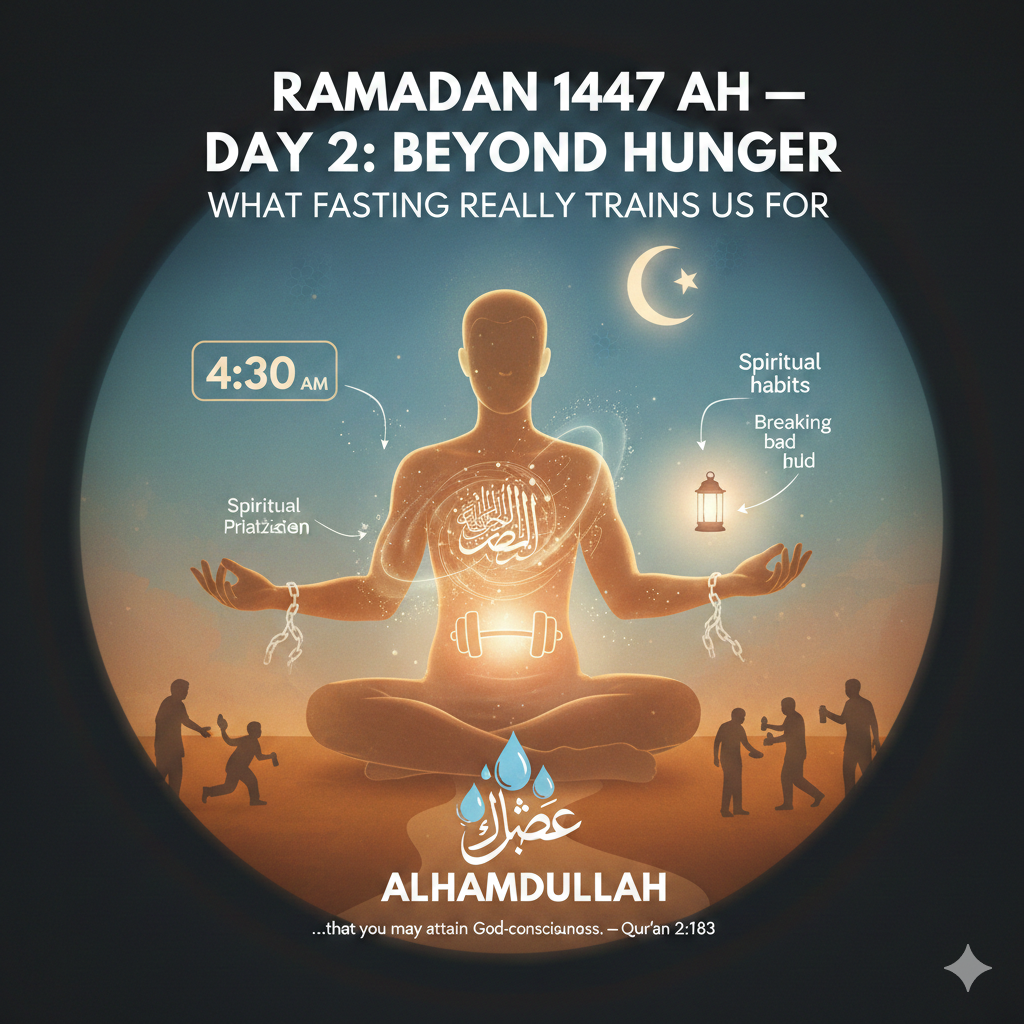
"Fasting is prescribed for you as it was prescribed for those before you, that you may attain God-consciousness." — Qur'an 2:183
Assalamu Alaykum wa Rahmatullah wa Barakatuh,
Day 1 is in the books. Alhamdulillah.
Your stomach is probably confused. Your caffeine-deprived head might be pounding. Your internal clock is wondering why you're awake before dawn when just yesterday you were sleeping like the dead.
Welcome to the discomfort zone.
And that's exactly where we need to be.
Because fasting was never meant to be comfortable. If Allah wanted us to simply abstain from food and drink, He could have made the fast about dry swallowing or symbolic gestures. Instead, He gave us hunger. Real, growling, can't-ignore-it hunger. Thirst that makes water taste like heaven at Maghrib. Fatigue that makes you question why you're doing this.
There's wisdom in that discomfort.
The Training Ground
Think of Ramadan as a gym — but for your soul.
When you go to the gym, you lift weights that challenge your muscles. You don't lift what's easy; you lift what breaks down the fibers so they rebuild stronger. The burn tells you it's working.
Fasting is the same. The hunger you feel? That's your ego being told it's not in charge. The thirst? That's your priorities being rearranged. The fatigue? That's your body learning that your spirit leads, not follows.
The Prophet ﷺ said in a hadith qudsi that Allah declares:
"Every deed of the son of Adam is for him, except fasting. It is for Me, and I will reward it. He leaves his food, drink, and desires for My sake." — Bukhari & Muslim
Notice what's being left: not just food and drink, but desires. The Arabic word is shahwah — that deep pull toward gratification. When you fast, you're telling your nafs (ego): You don't run this show. Allah does.
What Fasting Trains You For
1. Self-Control in Moments of Anger
You know that short fuse that appears when you're hungry? It's real. Blood sugar drops. Irritability rises. Patience thins.
And that's exactly when fasting does its work.
The Prophet ﷺ gave specific instructions for the fasting person who's provoked:
"If someone fights him or insults him, let him say: 'I am fasting, I am fasting.'" — Bukhari & Muslim
Not "I'll show you." Not an escalation. A reminder — to himself first, to the other person second — that something bigger than this argument is happening. You're in training. Don't let the provocation break your workout.
I tried this once. A family member said something that normally would've triggered a response. My blood heated. My mouth opened. Then I remembered: I'm fasting. So I said nothing. Walked away. Came back later and found the issue had dissolved on its own. The anger passed because I didn't feed it.
Fasting trains you to let emotions pass without acting on them.
2. Gratitude That Goes Beyond Words
We say "Alhamdulillah" a lot. Sometimes it rolls off the tongue without touching the heart.
But try going without water for 16 hours. Then take that first sip at Maghrib.
Suddenly "Alhamdulillah" means something. You feel the blessing of water. You understand why the people of Paradise will be given drinks that taste better than anything on earth — because you've experienced real thirst and real relief.
Allah says:
"And if you should count the favors of Allah, you could not enumerate them." — Qur'an 16:18
Fasting helps you count. It turns abstract blessings into tangible experiences.
3. Empathy That Moves You to Action
It's one thing to know intellectually that people are hungry. It's another to feel it in your own stomach.
When your stomach growls at 3 PM and you still have hours until iftar, you get a tiny taste of what millions experience daily — not by choice, but by circumstance. That taste should move you.
The Prophet ﷺ was the most generous of people, and he was most generous in Ramadan. He fed others. He gave. He didn't let his hunger go to waste.
The question isn't just: Will you feel empathy? The question is: What will you do with it?
4. Spiritual Prioritization
Before Ramadan, your morning probably looked like: phone, coffee, work, distractions. In Ramadan, your morning shifts: Fajir, Qur'an, du'a, Suhoor gratitude.
Something shifts when you prioritize worship before food. You realize the world doesn't collapse if you don't check Instagram immediately. You discover that the peace of sitting with Qur'an at dawn is better than the dopamine hit of a morning scroll.
This is training for the rest of the year. If you can prioritize Allah in Ramadan, you can carry some of that priority forward.
5. Breaking Bad Habits
Neuroscience tells us it takes about 21-30 days to form or break a habit. Interesting timing, isn't it?
Ramadan is the perfect window to drop something that's been controlling you. Gossip? Social media addiction? Unnecessary spending? The anger habit? The late-night binge-watching?
You're already in a state of abstinence. Leverage it. Every time you resist something haram or even unnecessary, you're rewiring your brain. You're telling yourself: I am not a slave to this. I am a slave to Allah alone.
A Note on the Struggle
Let's be real: some days will be harder than others. You might break your fast with junk food and regret it. You might skip Tarawih because you're exhausted. You might snap at your kids and feel like a hypocrite.
That's not failure. That's the struggle of being human.
The beauty of fasting isn't in perfection — it's in the return. You slip, you repent, you try again. That's the training. That's the workout.
Du'a for Today
"O Allah, teach us what fasting really means. Train our souls through this hunger. Soften our hearts through this thirst. Let every difficult moment be a lesson, and every moment of ease be gratitude. Make us among those who emerge from Ramadan truly changed. Ameen."
Today's Challenge
Identify one bad habit you'd like to break. Just one. Every time you feel the urge to engage in it today, remember: I am fasting. Let your fast be the reason you pause. If you slip, don't despair. Try again tomorrow. That's the training.
Conclusion
Ramadan is not a diet plan. It's a transformation program.
The hunger is the tool. The thirst is the teacher. The fatigue is the fuel.
When you feel the discomfort today, don't just endure it — engage with it. Ask yourself: What is this teaching me? What is Allah showing me through this? Because the One who prescribed the fast didn't do it to torture you. He did it to elevate you.
See you tomorrow in sha Allah for Day 3: The Qur'an and I — Rebuilding a Broken Relationship.
Yaumul Arbi’aa’, 2nd Ramadan 1447 // Thursday, 19th February 2026
Your email address will not be published. Required fields are marked *